
At client meetings, it usually takes me three tries to explain why a report labeled “March conversion rate” tells us very little about March leads. The report divides all payments received in March by the leads that arrived that month. Those numbers come from different groups: some March payments came from customers acquired in January or February. That ratio compares March's payments with the new leads from that month. To measure the March cohort's conversion rate, follow those leads and count how many pay over time.
I take the leads from one week and track when each one pays: after one, two, or three weeks. That shows where the team is losing momentum and where to focus. Earlier cohorts also give us a basis for estimating future payments, especially over the next few months. We can forecast the money that's on its way.
I decided to try explaining this through Rome.
Yes, ancient Rome.

The emperor has three commanders:  Mark,
Mark,  Titus, and
  Lucius. Each month, each commander gets 100 new villages and is tasked with negotiating tribute. Legionaries visit the elders, discuss terms, and wait for a decision. Once a village agrees, it sends one chest of gold to Rome. Some negotiations take only a few days. Others drag on until harvest. So the commanders keep working January's villages after February and March lists arrive.
In March, the treasurer brought the emperor a report:
| Commander | New villages assigned in March | Chests received in March |
|---|---|---|
| Mark |
100 | 45 |
| Titus |
100 | 39 |
| Lucius |
100 | 39 |

“Mark has made Rome proud!” The emperor slapped his palm on the table. “Each commander received 100 villages, and Mark brought back 45 chests. Forty-five percent! Give him the golden laurel wreath.”
The treasurer set down his quill.

“Your Majesty, hold the wreath for a moment.”
“You wrote down 45 yourself. The others brought 39.”
“I did. But which villages sent those 45 chests?”
March payments came from leads created in different months
The treasurer matched March's chests to the village lists. The month in each column tells us when negotiations began. Every chest in this table arrived in March.
| Commander | January cohort | February cohort | March cohort | Total received in March |
|---|---|---|---|---|
| Mark |
25 | 15 | 5 | 45 |
| Titus |
5 | 18 | 16 | 39 |
| Lucius |
4 | 15 | 20 | 39 |
| Total | 34 | 48 | 41 | 123 |
“Why did Titus and Lucius receive only a handful of chests from their January villages?” the emperor asked.
“Because this table shows March alone. In January and February, Titus received 35 chests from his January list and Lucius received 37. Mark received 13 over the same period. The elders in his villages took longer to confer and waited for the harvest; they sent another 25 chests in March.”
The emperor looked at the March column. So far, Mark's new villages had sent the fewest chests.
“All right,” said the emperor. “But perhaps Mark always starts slowly and brings in more later?”
The treasurer pulled out two more lists.
Compare conversion among leads at the same age
The treasurer laid the January, February, and March lists side by side. Each commander had received 100 new villages in each month. The table shows the share that had paid by the end of its first month.
| Commander | January cohort | February cohort | March cohort |
|---|---|---|---|
| Mark |
5% | 4% | 5% |
| Titus |
15% | 16% | 16% |
| Lucius |
18% | 20% | 20% |
At the same point in the cycle, Mark is behind in all three cohorts.
The treasurer checked the second month too: Mark was still behind. The March villages had not reached their second month yet.
“Then who gets the wreath?” asked the emperor.
“Let’s wait until the negotiations are finished. For a current view, we should compare villages at the same stage.”
The treasurer grouped the villages by the month of their first conversation and tracked when each one sent a chest. That let him compare commanders one month after each new group arrived, then two months, then three. That is cohort analysis.
“Same-age villages,” repeated the emperor. “That’s how I want to see the report.”
A weak cohort shows which deals need attention
In April, 94 chests arrived at the treasury. The treasurer brought the emperor a list of the new villages.
“Twelve of the new villages have paid,” he said. “At this point, we usually hear from about 40.”
The emperor set aside the treasury report.
“What happened to the rest?”
“One village council still hasn't managed to meet. Another is waiting for the harvest, but no one agreed on a date. And here, our letter is under the headman's jug. The legionaries visited once and moved on.”
“Send them back to the April villages. Set a council date, agree on a timeline, and get that letter out from under the jug.”
The commanders reopened the April lists. The legionaries returned to villages where talks had stalled. In May, that cohort sent 60 chests. Earlier cohorts had sent about 50 in their second month. April was catching up: several councils met after a follow-up visit, and the promised chests made it to Rome.
“Keep the April list,” said the emperor. “We still have work to do there.”
A strong revenue quarter can conceal a weak cohort
The treasurer gathered all the payments from January through June. Each row is a cohort: villages first contacted in that month. Each cell counts new chests that arrived in the calendar month at the top. A dash means the cohort did not exist yet; zero means no chest arrived that month.
| First contact | January | February | March | April | May | June |
|---|---|---|---|---|---|---|
| January cohort | 38 | 47 | 34 | 8 | 0 | 0 |
| February cohort | — | 40 | 48 | 27 | 7 | 0 |
| March cohort | — | — | 41 | 47 | 27 | 7 |
| April cohort | — | — | — | 12 | 60 | 30 |
| May cohort | — | — | — | — | 45 | 50 |
| June cohort | — | — | — | — | — | 42 |
| Total per month | 38 | 87 | 123 | 94 | 139 | 129 |
The first quarter brought in 248 chests; the second brought in 362. In the second quarter, villages from more cohorts were paying at the same time. The higher total makes April's slowdown easy to miss.
By June, the first three cohorts had each completed a full four-month cycle for every commander. Each commander had received 100 villages in each of January, February, and March. The table shows the chests each commander received from each group during its first four months.
| Commander | January cohort | February cohort | March cohort | Total from 300 villages |
|---|---|---|---|---|
| Mark |
41 | 29 | 29 | 99 |
| Titus |
42 | 46 | 46 | 134 |
| Lucius |
44 | 47 | 47 | 138 |
All 45 of Mark's March chests were in the treasury. For three months running, fewer villages in his new cohorts paid than in Titus's and Lucius's; the gap remained after four months.
Lead source matters when comparing sales managers
“A wreath for Lucius?” The emperor pointed to the last column.
The treasurer unfolded the map. Of Mark's 300 villages, only 20 stood along the trade road. Lucius had 220 there. The rest of Mark's villages were hidden in the mountains: they took longer to reach, and a poor harvest made tribute harder to collect.
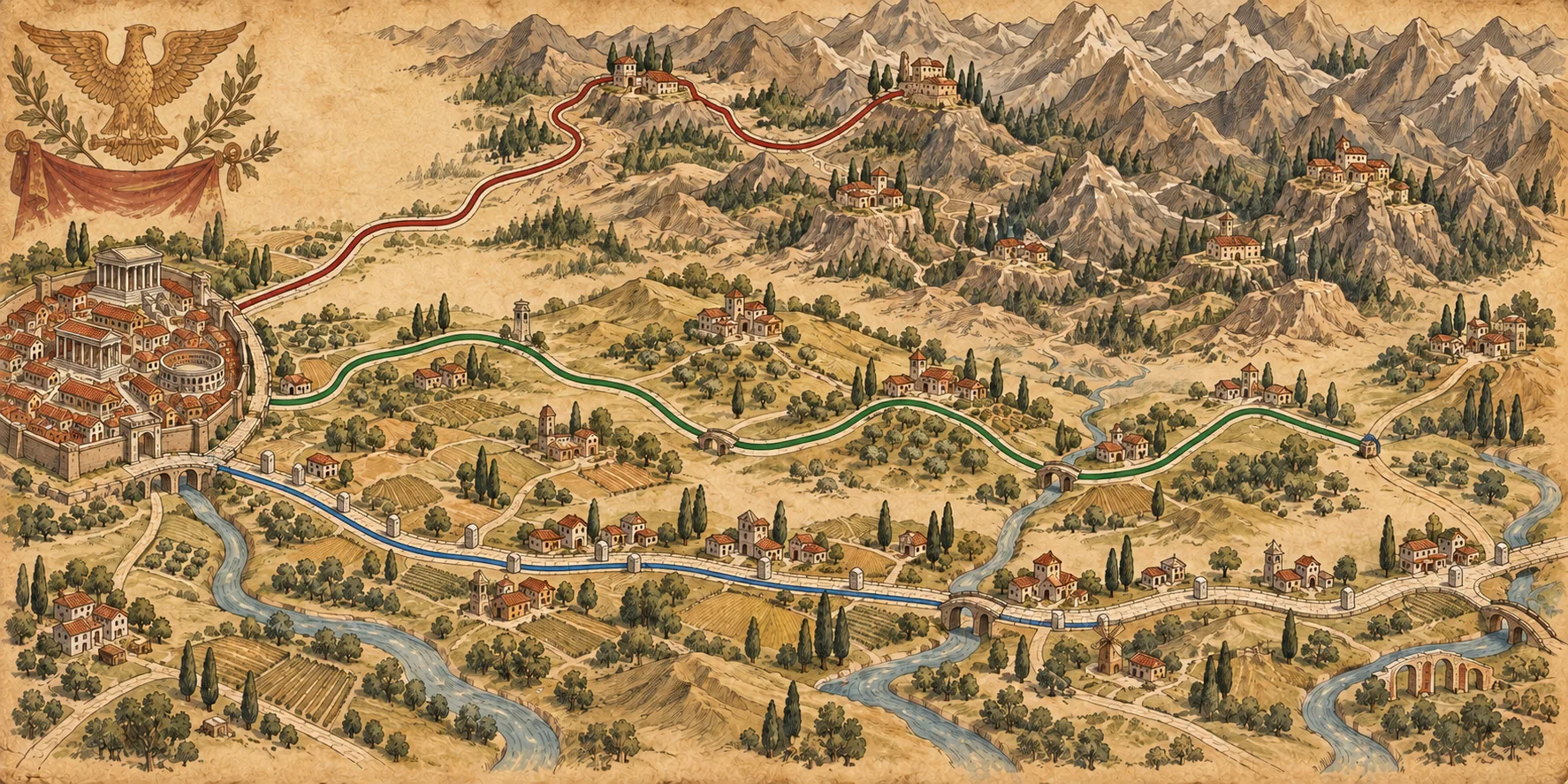
- Mark · 20 roadside villages out of 300
- Titus
- Lucius · 220 roadside villages out of 300
“I split the villages by terrain,” said the treasurer. “By month four, about one in two roadside villages has paid; in the mountains, it's one in three. That's true for all three commanders. Mark was assigned more difficult negotiations.”
“Split the next lists evenly: give each commander both roadside and mountain villages,” said the emperor. “We'll revisit the wreath in four months.”
Use past cohorts to forecast when payments will arrive
“In July, we'll send legionaries to 600 new villages and 450 in August,” said the emperor. “Then 300 a month again. How many chests should we expect by the end of October?”
“From the first three lists, about 40 villages out of every 100 pay within four months,” said the treasurer.
“Then the 600 July villages should bring in around 240 chests. How many will arrive in July?”
“About 80. Negotiations with the rest will continue in August, September, and October.”
The treasurer opened the January, February, and March lists. Each cohort had completed four months, so he could see how many chests usually arrived in its first, second, third, and fourth month. In the first month, about 40 chests arrived from every 100 villages. July's list had twice as many, which explained the estimate of 80.
The August list would be one and a half times the usual size. The treasurer projected payments from each new cohort and added the tribute expected from villages contacted between April and June, where negotiations were already under way. The rows show village cohorts; the columns show the months when their chests were expected to arrive.
| Village cohorts | July | August | September | October |
|---|---|---|---|---|
| April–June: already in progress | ≈83 | ≈36 | ≈7 | ≈0 |
| July: 600 villages | ≈80 | ≈94 | ≈58 | ≈14 |
| August: 450 villages | — | ≈60 | ≈70 | ≈44 |
| September: 300 villages | — | — | ≈40 | ≈47 |
| October: 300 villages | — | — | — | ≈40 |
| Total per month | ≈163 | ≈190 | ≈175 | ≈145 |
“We expect about 145 chests in October,” said the treasurer. “Forty from the October list, and the rest from earlier cohorts. About 670 over the four months.”
The emperor traced July's row with his finger: one cohort would send chests over four months. August's villages would keep paying into November.
“What if July's assignment is mostly mountain villages?”
“Then we'll calculate a separate forecast for them and check whether the legionaries can visit all 600 villages. The mix of villages and each commander's work also affects tribute.”
The treasurer expected roughly half of July's tribute from villages already in negotiation. October depended much more on future lists. April's villages might move forward after the follow-up visits; the treasurer would update the forecast as new chests arrived.
Use CRM cohorts to spot slowdowns and forecast payments
In a CRM, villages become leads, chests become payments, and commanders become sales managers. The month of the legionaries' first visit becomes the month a lead enters the pipeline. A customer may be getting approval, waiting for a budget, or discussing terms. While that happens, the manager is already working new leads.
To build the treasurer's table, the CRM needs a lead ID, its creation date, the date of its first payment, the assigned manager, and the lead source. Group leads by the week or month they arrived, then track what share has paid within 30, 60, or 90 days. Leads that have not paid yet stay in their original cohort.
Mark's 45 March chests came from villages in several cohorts. Five villages from his new March group paid in the first month: a 5% conversion rate. Lucius was at 20% at the same point in the cycle.
For a long sales cycle, track intermediate steps too. For example, what share of leads books a meeting within one week, two weeks, or a month? That requires a timestamp for each stage change in the CRM.
When a cohort falls behind, open its unfinished deals. Which customers have not heard from the team in a while? Where is approval stuck? Managers can follow up on those leads; next month, the same row will show how payments progressed.
The trade road and the mountains stand for lead sources. Perhaps Lucius received more referrals while Mark handled more cold leads. The treasurer compared roadside and mountain villages separately; sales teams can compare managers using leads of the same age and source. If a lead moved between managers, decide in advance who gets credit for the payment.
Forecasting requires the leads already in the pipeline and a monthly plan for new leads. If about 10% usually pay within four months, 600 new leads should produce about 60 payments over that period. Past cohorts help estimate when those payments will arrive. Add the expected payments from each cohort to build a month-by-month forecast. To forecast revenue, account for deal size as well.
Mark kept coming back to those 45 chests in March. The treasurer would open Mark's March list. There were five.